
Root Canal Perth: Save Your Tooth & Your Budget
Prices at Perth Prime Dental
| Root canal treatment (crown extra) | from $1,200 |
Every case is different, so we assess you first and give you a written quote before any treatment. No pressure. Payment options include Afterpay, Zip, humm and DentiCare.
Need a tooth out instead? See tooth extraction in Perth CBD.
In short: Root canal treatment removes infected or inflamed pulp from inside a tooth, then cleans, disinfects and seals the root canals so you can keep your natural tooth instead of having it removed. At Perth Prime Dental in the Perth CBD it is done under local anaesthetic over one or more visits, and costs from $1,200 (a crown, if needed, is extra). We examine the tooth and take X-rays first, then give you a written quote.
What is root canal treatment?
Root canal treatment (also called endodontic treatment) treats the inside of a tooth. When the soft tissue in the centre of the tooth, the pulp, becomes infected or inflamed, your dentist removes it, cleans and shapes the narrow canals that run through the roots, and seals them. This controls the infection and keeps the tooth in place.
It is a common, well-established procedure. It works predictably when the tooth is a good candidate for treatment and is finished with a strong, well-sealed final restoration, such as a filling or a crown.
Inside a tooth: why the pulp matters
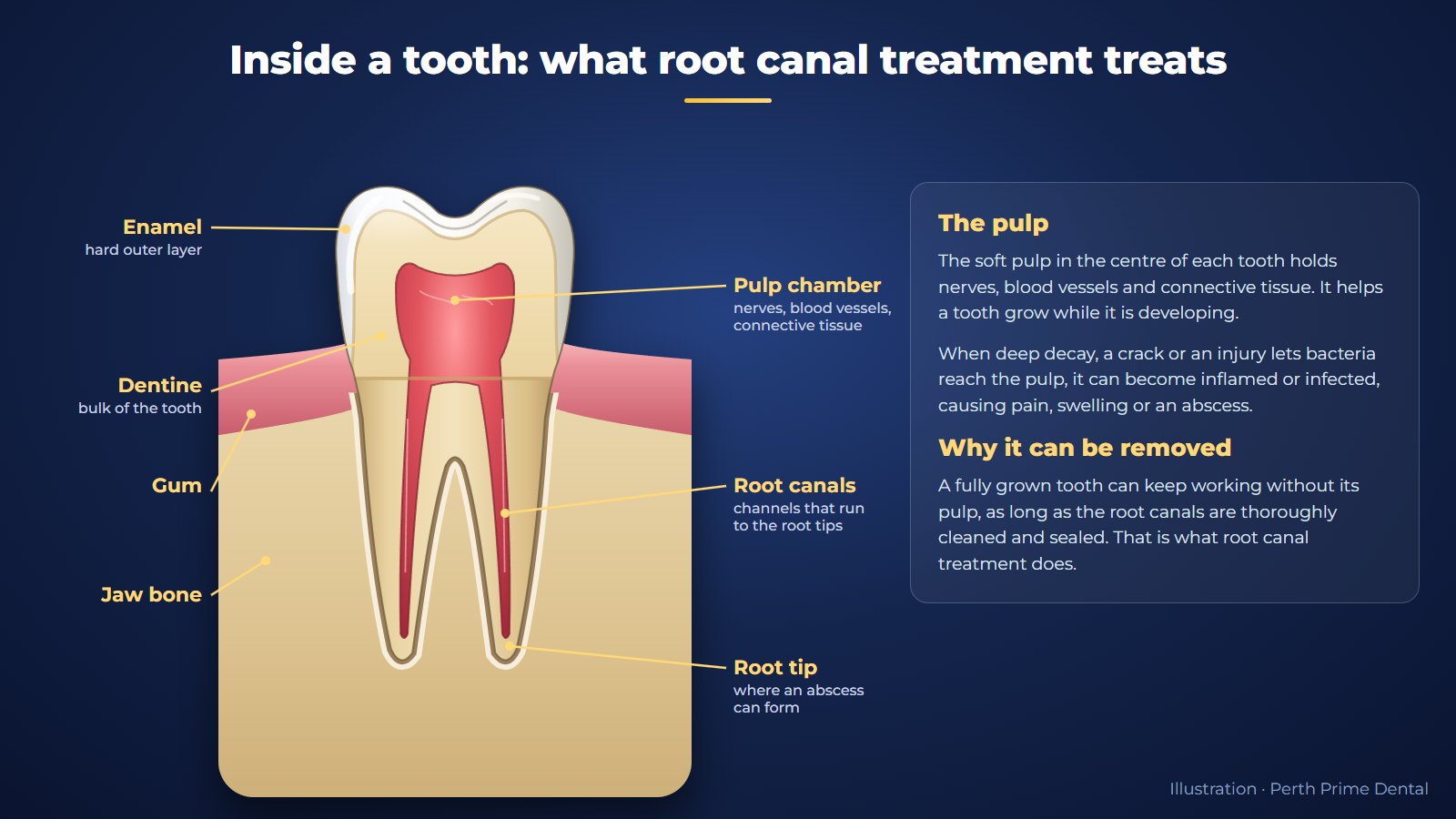
The pulp contains nerves, blood vessels and connective tissue. It helps a tooth form while it is growing. Once a tooth is fully developed, it can keep working without the pulp, as long as the root canal system is properly cleaned and sealed. That is why root canal treatment can save a tooth that would otherwise need to come out.
Signs you might need a root canal
Bacteria can reach the pulp through deep decay, a crack, a large or leaking filling, or an injury. You might notice:
- toothache that lingers, throbs or wakes you at night
- sensitivity to hot or cold that stays after the food or drink is gone
- pain when you bite or chew
- swelling of the gum, a pimple-like spot on the gum, or facial swelling
- a tooth that has darkened
Some infected teeth cause no pain at all and are found on an X-ray at a check-up. If you have swelling or severe pain, see our emergency dentist page: emergency appointments are $99.
Root canal treatment, step by step
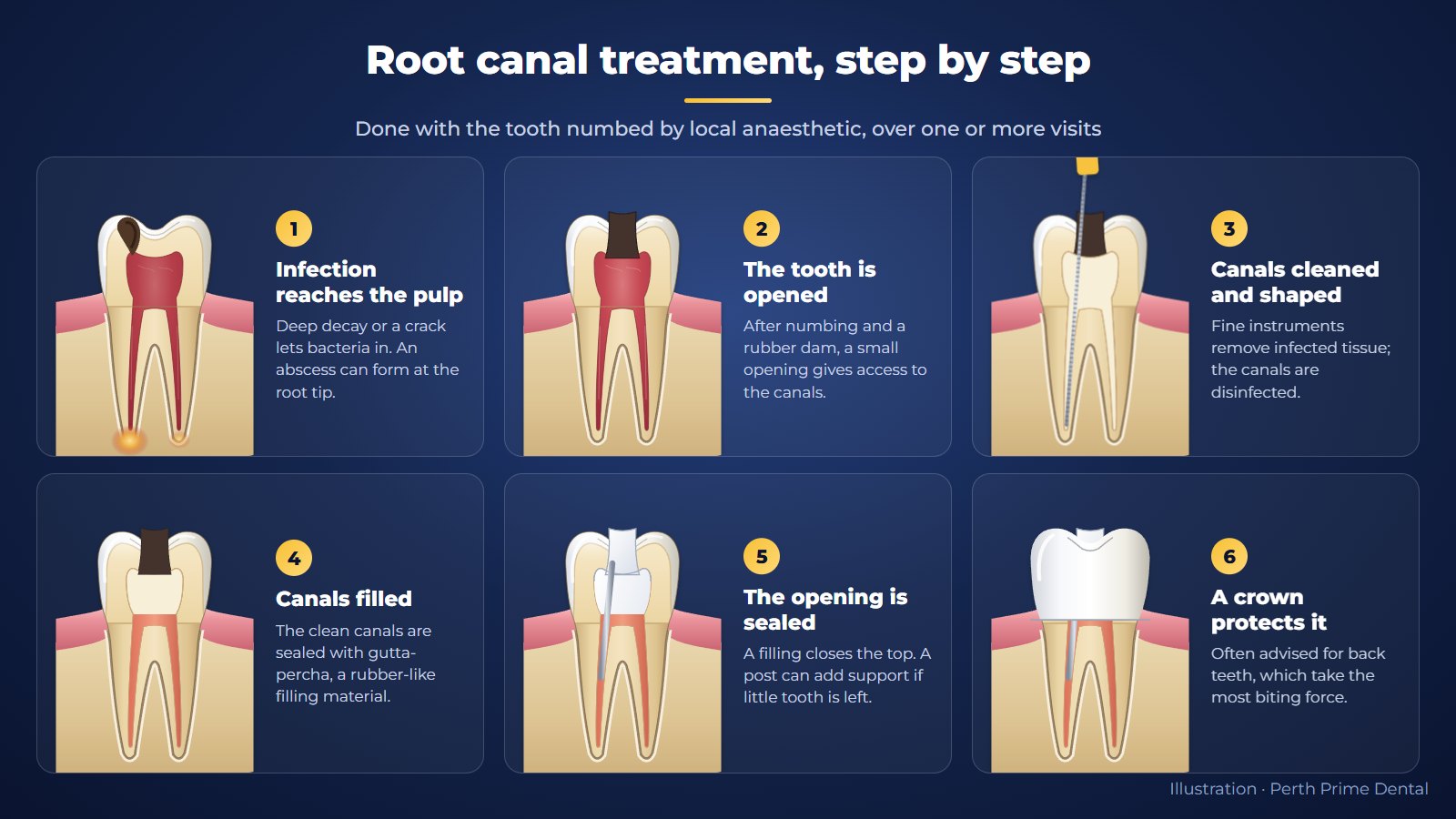
- Assessment. Your dentist examines the tooth and takes X-rays to see how far the damage goes and whether the tooth can be saved.
- Numbing and isolation. Local anaesthetic numbs the tooth. A thin rubber sheet (a rubber dam) is placed around it to keep the area clean and dry.
- Access. A small opening is made in the top of the tooth to reach the pulp chamber and the canals.
- Cleaning and shaping. The infected or inflamed tissue is removed, and the canals are carefully cleaned, shaped and disinfected. Sometimes an antibacterial, anti-inflammatory medicine is left inside the canals between visits to settle the inflammation and kill remaining bacteria.
- Filling the canals. The clean canals are filled and sealed with gutta-percha, a rubber-like material, to stop bacteria getting back in.
- Sealing the tooth. A filling closes the opening. If not much tooth is left, a post can be placed in a canal for extra support.
- Protecting the tooth. Back teeth often need a crown afterwards, because a root-filled tooth can be more brittle and molars take heavy biting forces.
Video transcript
Root canal treatment explained Infection reaches the pulp. Deep decay or a crack lets bacteria into the pulp, the nerves and blood vessels inside the tooth. An abscess can form at the root tip. The tooth is numbed and opened. Local anaesthetic numbs the tooth, and a small opening gives access to the canals. Canals cleaned and shaped. Fine instruments remove the infected tissue, and the canals are disinfected. Canals filled. The clean canals are sealed with gutta-percha, a rubber-like material, to keep bacteria out. The tooth is sealed. A filling closes the opening. Sometimes this takes more than one visit. A crown protects it. Back teeth often need a crown, because a root-filled tooth can be more brittle.
How many visits does a root canal take?
It depends on the tooth and the infection. Some teeth are finished in one visit; others need two or more, with a temporary filling between appointments. Front teeth usually have one canal, while molars often have three or four, some of them curved or narrow, so they take longer. Your dentist will tell you the plan before you start.
Recovery: what is normal afterwards
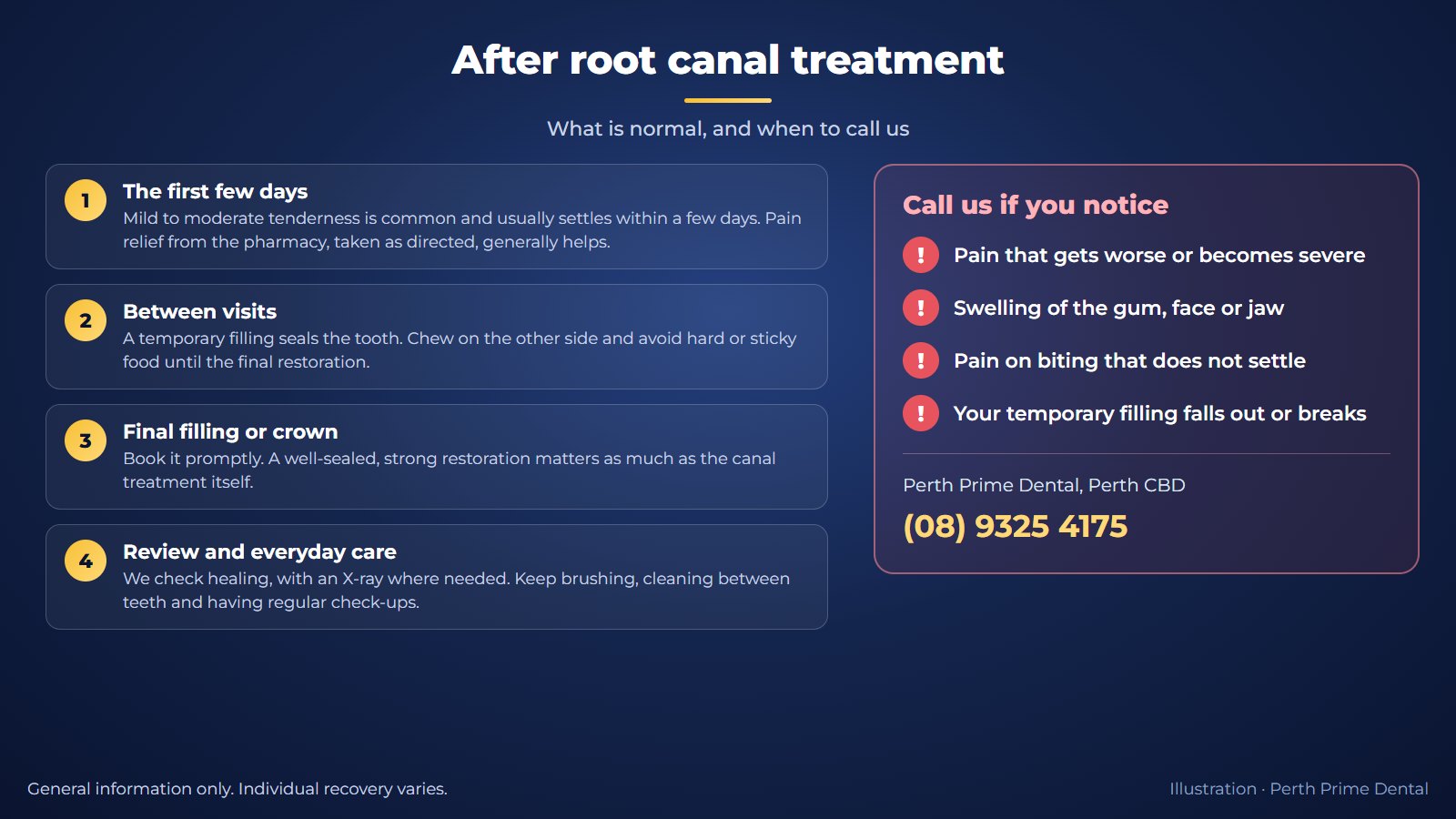
- The first few days: mild to moderate tenderness is common and usually settles within a few days. Over-the-counter pain relief, taken as directed, generally helps.
- Between visits: chew on the other side and avoid hard or sticky food while you have a temporary filling.
- Final restoration: have the permanent filling or crown placed promptly. A good seal on top is as important as the treatment inside the tooth.
- Follow-up: we review the tooth, with X-rays where needed, to check that it is healing. Keep brushing twice a day, clean between your teeth and keep up regular check-ups.
When to contact us
Call us on (08) 9325 4175 if you have:
- pain that is getting worse or becomes severe
- swelling of the gum, face or jaw, or your face looks uneven
- discomfort when biting that doesn’t settle
- a temporary filling that falls out, breaks or feels loose
Symptoms that persist or come back can mean ongoing infection, complex canal anatomy or a crack in the tooth, and the tooth may need further assessment.
Possible risks of root canal treatment
Root canal treatment is well established and predictable, but like any medical or dental treatment it has risks. Ask your dentist about any concerns before you start. How well the tooth does in the long term depends on how much healthy tooth is left and on the quality and timing of the final restoration.
| Risk | What it means |
|---|---|
| Pain or discomfort | Mild to moderate soreness is common and usually settles within a few days. Pain that persists or worsens should be checked. |
| Infection that persists or returns | Treatment clears most infections, but sometimes infection remains or comes back. Options then include re-treatment, minor surgery at the root tip, or removing the tooth. |
| Discolouration | A root-filled tooth can darken over time, which shows most on front teeth. Internal whitening or a crown or veneer can help. |
| Losing the temporary filling | If a temporary filling comes out or leaks, bacteria can get back in. It should be replaced quickly; sometimes a temporary crown or band is used for extra protection. |
| Cracks | Teeth that need root canal treatment may already be cracked or weakened, and cracks can’t always be seen beforehand. This can affect the outcome, and not every tooth can be saved. |
| Losing the tooth | The aim is to keep your natural tooth, but results depend on its starting condition, how much tooth structure remains and the final restoration. In some cases the tooth still needs to be removed. |
Very occasionally, a tooth with unusual or complex anatomy is best treated by an endodontist (a registered specialist in root canal treatment). If we think that applies to you, we’ll explain why and arrange a referral.
How much does a root canal cost in Perth?
At Perth Prime Dental, root canal treatment is from $1,200, and most cases fall between about $1,200 and $2,200. A crown, if your tooth needs one, is quoted separately. The cost depends on:
- The tooth: front teeth usually have one canal; premolars and molars have more and take longer.
- The canals: curved, narrow or calcified canals need more time.
- The number of visits and X-rays needed.
- Whether the tooth needs a post, a core build-up or a crown afterwards.
You get a written quote before any treatment, and you can pay with HICAPS on the day or spread the cost with Afterpay, Zip, humm or DentiCare. See our payment options.
Root canal or extraction?
Keeping your own tooth is usually the first choice, but it isn’t always possible or sensible: for example, if the tooth is badly cracked below the gum or there isn’t enough of it left to restore. Removing a tooth costs less on the day, but the gap often needs replacing later with an implant, a bridge or a denture, which can cost more overall. Your dentist will go through the options with you.
- Tooth extraction: simple extraction from $250.
- Single dental implant: from $4,500, with a free implant consultation.
Preventing the need for a root canal
Most root canals start as decay that went unnoticed. Caught early, the same problem can often be fixed with a simple filling (from $200). Regular check-ups, brushing twice a day with fluoride toothpaste, cleaning between your teeth and wearing a mouthguard for contact sport all lower the risk.
Root canal treatment at our Perth CBD clinic
Perth Prime Dental is in London Court, 1/58 St Georges Terrace, Perth WA 6000. We assess the tooth, explain whether it can be saved and what it will cost, and only then start treatment. New patient visits are capped at $250, and emergency appointments are $99.
Book an appointment Call (08) 9325 4175
Frequently asked questions
Does root canal treatment hurt?
The tooth is numbed with local anaesthetic, so most people feel pressure rather than pain during treatment. Mild to moderate tenderness for a few days afterwards is common and usually manageable with over-the-counter pain relief.
How long does a root canal take?
An appointment often takes an hour or more. Some teeth are finished in one visit; others need two or more, with a temporary filling in between.
Do I need a crown after a root canal?
Back teeth often do, because a root-filled tooth can be more brittle and molars take heavy biting forces. Front teeth can often be restored with a filling. Your dentist will advise based on how much tooth is left.
How much is a root canal in Perth?
At Perth Prime Dental, root canal treatment is from $1,200, with most cases between about $1,200 and $2,200 depending on the tooth. A crown is extra. You get a written quote first.
Can a root canal fail?
Most root canal treatments succeed, but infection can persist or return, especially if the tooth is cracked or the final seal breaks down. Options then include re-treatment, minor surgery at the root tip, or removing the tooth.
Is it better to pull the tooth instead?
Keeping your natural tooth is usually preferred when it can be restored well. Extraction is cheaper on the day, but replacing the tooth later with an implant or bridge often costs more overall.
General information only. It is not a substitute for advice from your dentist, and individual outcomes vary.
