
Tooth Extraction and Wisdom Teeth Removal: What to Expect
In short: A tooth is removed when it can’t be saved or is causing problems. Wisdom teeth only need to come out if they’re causing trouble, such as infection, decay or pain, or are likely to. Most extractions are done in the chair with local anaesthetic. A simple extraction lifts out a tooth that’s fully through the gum. A surgical extraction is for teeth under the gum or bone, like many impacted wisdom teeth. Healing takes a week or two for the gum and a few months for the bone. Need a tooth out? See tooth extraction and wisdom teeth removal at Perth Prime Dental for prices and booking.
When does a tooth need to come out?
Saving a natural tooth is always the first choice. A dentist will usually suggest an extraction only when:
- the tooth is too broken down or decayed to repair with a filling or crown
- an infection in the nerve can’t be treated with root canal treatment, or you’d rather not keep the tooth
- advanced gum disease has left the tooth loose
- the tooth is cracked below the gum line
- a wisdom tooth is causing problems (see below)
If a tooth can be saved, we’ll tell you, along with the cost of each option, so you can decide.
Wisdom teeth: do they always need to come out?
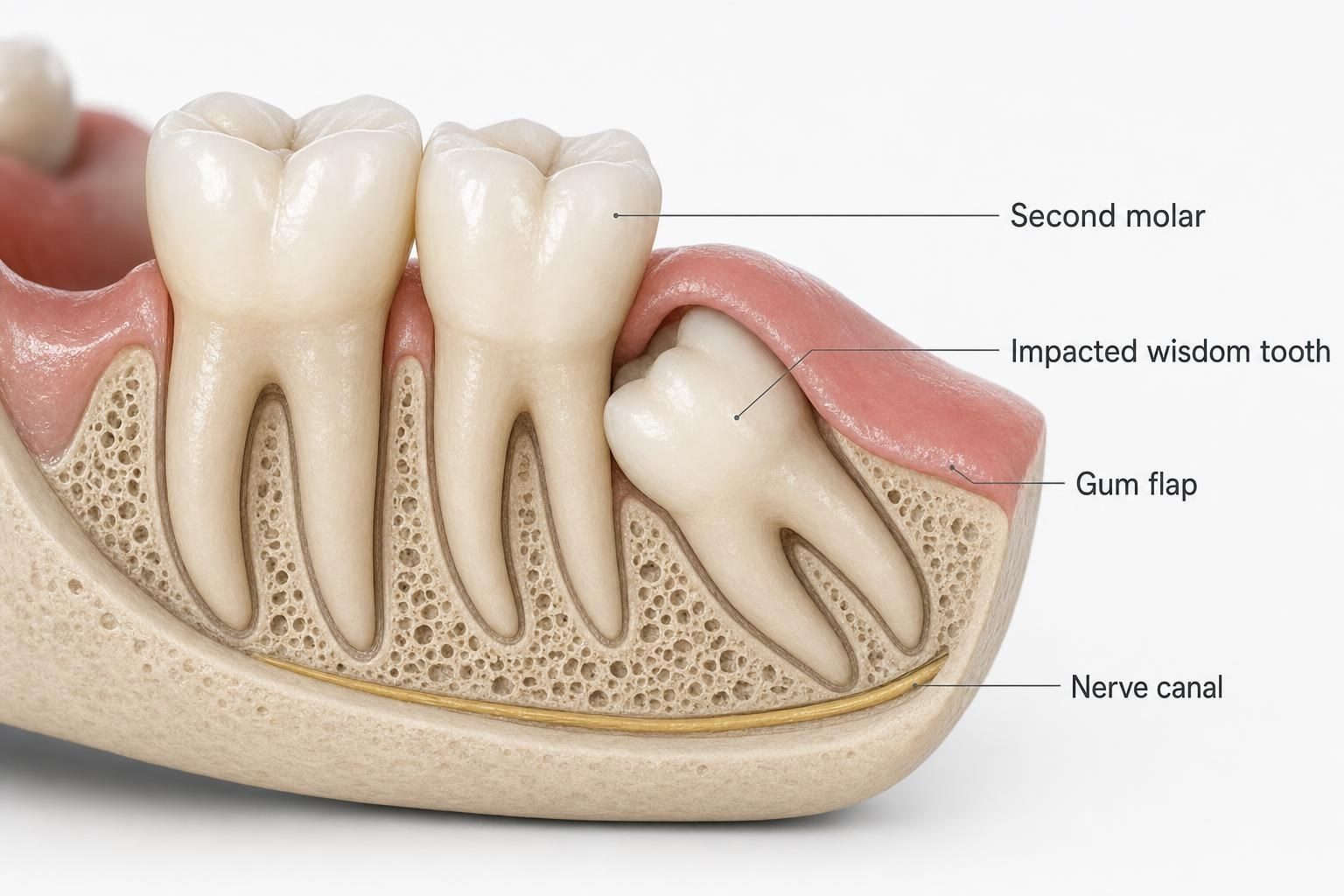
No. Wisdom teeth that come through straight, have room, and can be cleaned properly can stay. Problems usually start when a wisdom tooth is impacted, meaning it doesn’t have space to come through fully and gets stuck against the tooth in front or under the gum.
Signs that a wisdom tooth is causing trouble:
- pain or swelling of the gum at the very back of the mouth
- a bad taste or smell from that area
- a stiff jaw, or difficulty opening your mouth
- food packing between the wisdom tooth and the molar in front
- pain when biting on the back teeth
The most common problem is pericoronitis: infection under the gum flap over a partly erupted wisdom tooth. It often settles with cleaning and, if needed, antibiotics, but it tends to come back, which is why removal is often recommended after repeated episodes. An impacted wisdom tooth can also make the back of the healthy molar in front hard to clean, leading to decay or gum disease there.
An X-ray shows the position of the wisdom tooth, its roots, and how close they are to the nerve in the lower jaw. That’s how we decide whether it should come out, and whether it can be done in the chair.
Simple or surgical extraction?
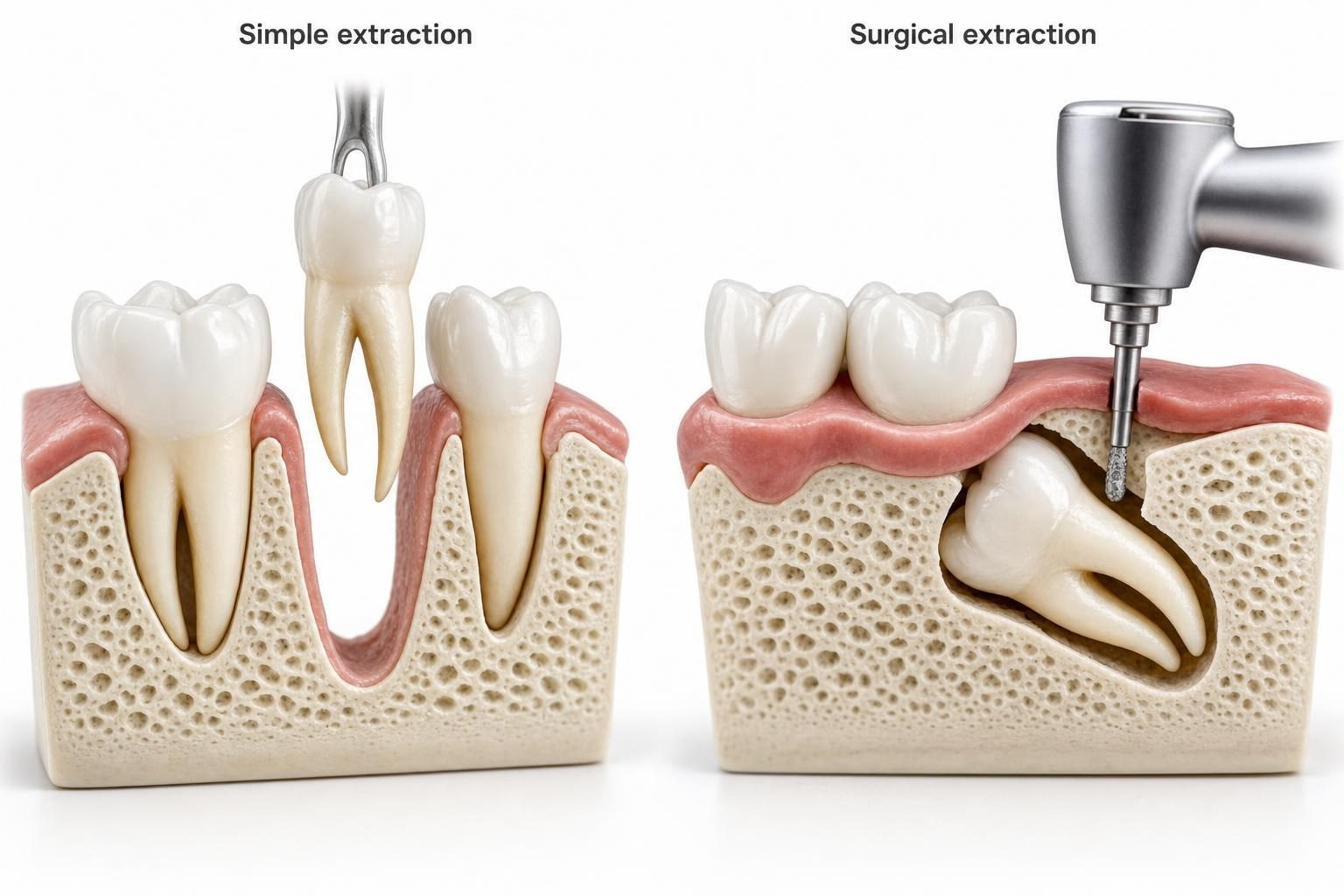
Simple extraction. For a tooth that’s fully through the gum. After the area is numb, the tooth is gently loosened in its socket and lifted out in one piece. You’ll feel pressure but should not feel sharp pain. If you do, tell us and we’ll give more anaesthetic.
Surgical extraction. For a tooth that’s under the gum or bone, has curved roots, or is likely to break. A small flap of gum is folded back, a little bone may be removed, and the tooth is often divided into pieces so each can come out with less force. A few stitches help the gum heal. Many impacted wisdom teeth are removed this way, in the chair, with local anaesthetic.
When we refer you. Some wisdom teeth are very deep or sit right against the nerve, and some people prefer to have several removed at once while asleep. In those cases, an oral and maxillofacial surgeon, often working in a hospital or day-surgery setting, may be the better choice. If that applies to you, we’ll explain why and refer you.
What happens at your appointment
- Examination and X-ray to check the tooth, its roots and the surrounding bone. Tell us about any medicines you take, especially blood thinners or bone medications, and any medical conditions.
- Your options and a written quote. Nothing goes ahead until you’ve agreed.
- Numbing. Local anaesthetic numbs the tooth, gum and surrounding area.
- The extraction, simple or surgical, as explained above.
- Gauze and aftercare. You bite on gauze to help a blood clot form, and we go through the aftercare with you and give it to you in writing.
Nervous about it? Tell us at the start. We’ll explain each step before we do it, and you can raise a hand to pause at any time.
Healing: what to expect day by day
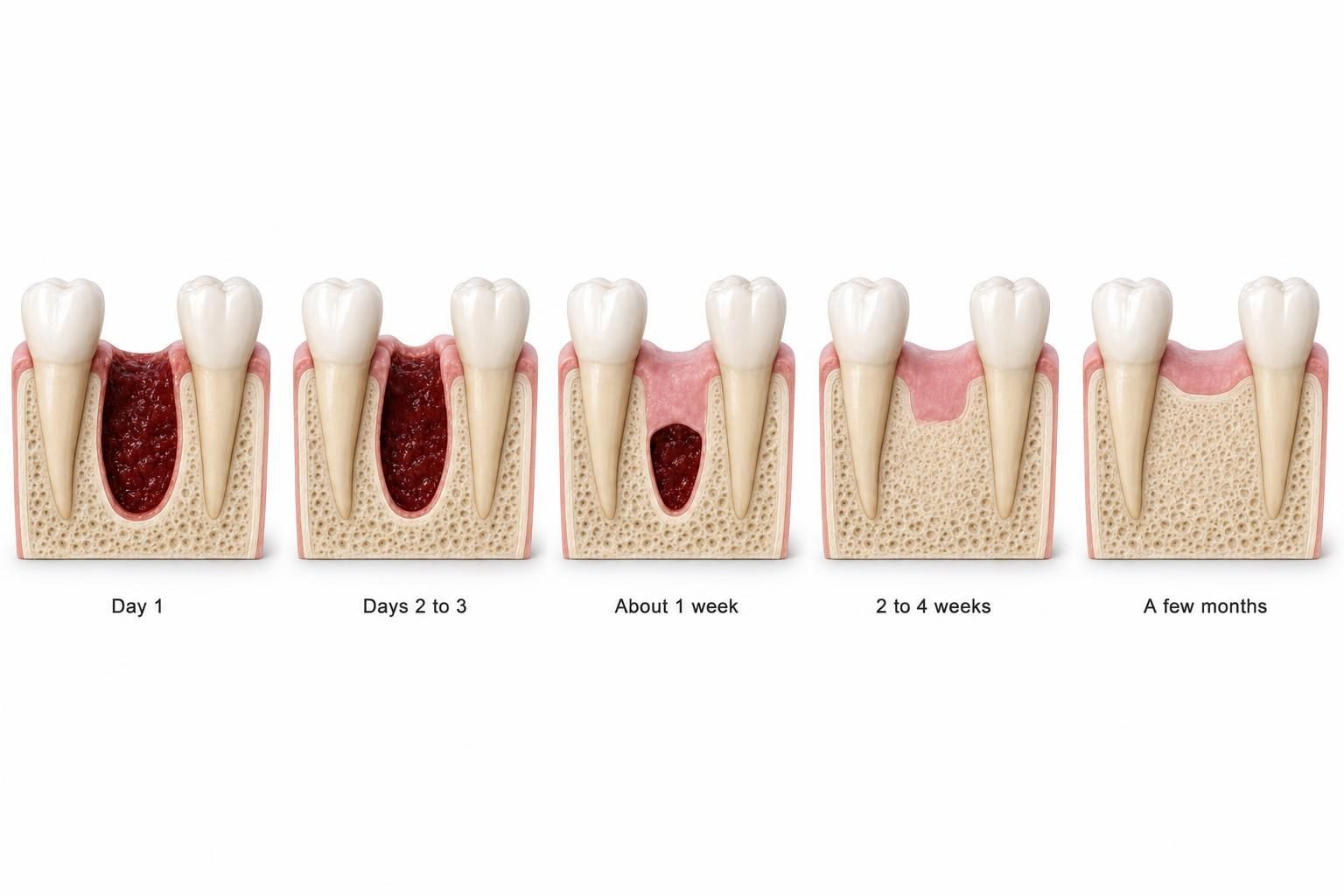
First 24 hours: keep biting on gauze until the bleeding settles. Don’t rinse, spit, smoke, vape or drink through a straw, as these can dislodge the clot. Rest, keep your head raised, and use a cold pack on your cheek on and off. Eat soft, lukewarm food on the other side.
Days 2–3: swelling and soreness are usually at their worst, then they ease. From the second day, rinse gently with warm salt water after meals. Take pain relief as advised by your dentist.
About a week: the gum is closing. A white-yellow layer over the socket is normal healing tissue, not pus. Stitches dissolve or are removed.
2–4 weeks: the gum has usually closed over, and chewing on that side gets easier. The bone underneath keeps filling in over the next few months.
For the full list of do’s and don’ts, see our home care instructions.
Dry socket: the one to watch for
Call us if pain gets worse 2–4 days after the extraction instead of better, especially with a bad taste, bad breath, or a socket that looks empty. This is usually dry socket: the blood clot has come out or broken down, leaving the bone exposed. It isn’t an infection, and it’s treatable. We clean the socket and place a soothing dressing, which usually eases the pain quickly.
Dry socket is more likely after lower wisdom tooth removal and in people who smoke or vape. Protecting the clot in the first few days, as described above, is the main way to prevent it.
Get help straight away for bleeding that won’t stop with 30 minutes of firm pressure on gauze, swelling that keeps spreading after day 3, a fever, or difficulty swallowing or breathing. For breathing or swallowing problems, call 000. Our dental emergency guide explains where to go.
Other risks
Every extraction carries some risk, and your dentist will explain the ones that apply to your tooth. Besides dry socket, these include bleeding, swelling, bruising, infection, and a stiff jaw for a few days. With lower wisdom teeth whose roots sit close to the nerve, there’s an uncommon risk of numbness or tingling in the lip, chin or tongue. This is usually temporary, but rarely it can be lasting. That’s why the X-ray is checked first, and why some cases are referred to a specialist.
Replacing an extracted tooth
Wisdom teeth don’t need replacing. For other teeth, especially at the front or a molar you chew on, a gap can let neighbouring teeth drift and the bone shrink over time. Your options include:
- A dental implant: a fixed replacement that doesn’t involve the teeth either side. Single implants start from $4,500, and the implant consultation is free. In selected cases, an implant can be placed at the same visit as the extraction (an immediate implant).
- A bridge, which is attached to the teeth either side, from $4,500.
- A removable denture.
If you’re thinking about an implant, tell us before the extraction. We may suggest bone grafting into the socket to preserve the bone for later.
What does it cost?
It depends on the tooth, its roots and whether a surgical extraction is needed, so you’ll get a written quote after your examination and X-ray. Current prices are on our tooth extraction page. Health fund rebates can be claimed on the spot with HICAPS, and payment options are available.
Need a tooth or wisdom tooth checked?
We’re in London Court, 1/58 St Georges Terrace, Perth, a short walk from Perth Underground. In pain now? An emergency appointment is $99, and we offer same-day appointments where possible.
Call (08) 9325 4175 Book online
Frequently asked questions
Does a tooth extraction hurt?
The area is numbed with local anaesthetic first, so you’ll feel pressure and movement but should not feel sharp pain. If you do, tell your dentist and more anaesthetic can be given. Some soreness afterwards is normal and usually eases after the first two to three days.
Do I need to have my wisdom teeth removed?
Not always. Healthy wisdom teeth that have come through straight and can be cleaned can stay. Removal is usually recommended when a wisdom tooth is impacted and causing problems such as repeated gum infection, decay, or damage to the tooth in front.
How long does it take to recover from a wisdom tooth extraction?
Swelling and soreness usually peak at two to three days and then settle. The gum generally closes over within two to four weeks, and the bone fills in over a few months. Surgical extractions usually take a little longer to settle than simple ones.
What is dry socket and how do I avoid it?
Dry socket happens when the blood clot in the socket is lost, leaving the bone exposed. It causes pain that gets worse two to four days after the extraction. To lower the risk, don’t smoke, vape, spit or use a straw in the first days. If it happens, call your dentist: it’s treatable.
General information only, not a substitute for advice about your own teeth. Any surgical or invasive procedure carries risks.
